A 3D-printed component can pass a functional test or fail after a few hours of use because of a wrong choice of material. Geometry matters, but it is not enough: loads, temperature, chemical agents, tolerances, finish and production process determine the result. This guide to engineering materials for additive manufacturing helps set up the selection in a practical way, starting from the real requirements of the part and not from the best-known material.
For functional prototypes, pre-series and finished parts, the right question is not which material is the best in absolute terms. It is which combination of material, technology and post-processing is most suited to the required function, the production volume and the context of use.
Engineering additive materials: start from the function
Before evaluating PA12, TPU or engineering resins, you need to define what the component must do. A mount for validating envelopes and assemblies has different requirements from a hinge, a cover subject to impact or a flexible element intended for repeated cycles.
The first parameter is the type of stress. For static loads, the material's ability to maintain shape and stiffness counts; for impacts, vibration and frequent snap-fits, toughness and fatigue resistance are also needed. If the part works near heat sources, or in the presence of oils, detergents or humidity, these factors become as decisive as the initial mechanical strength.
The required accuracy must also be assessed at quotation stage. Tolerances, calibrated holes, mating surfaces and thin walls require consideration of both the technology's capabilities and the behaviour of the material after printing and post-processing. A part well designed for CNC machining is not automatically ready for additive production: orientation, thicknesses, radii, functional clearances and internal geometries must be checked.
PA12: balance for mechanical parts and short runs
PA12 is one of the most widely used materials in industrial 3D printing with SLS technology. It is suited to technical components that require a good compromise between mechanical strength, toughness, dimensional stability and low weight. It is often chosen for housings, brackets, mounts, air ducts, jigs, fasteners, enclosures and components intended for advanced functional testing.
SLS technology builds the part by sintering polyamide powder layer by layer. Because the powder supports the geometry during production, traditional supports are not needed. This makes it possible to create internal channels, complex structures, undercuts and small batches of different parts in the same production cycle.
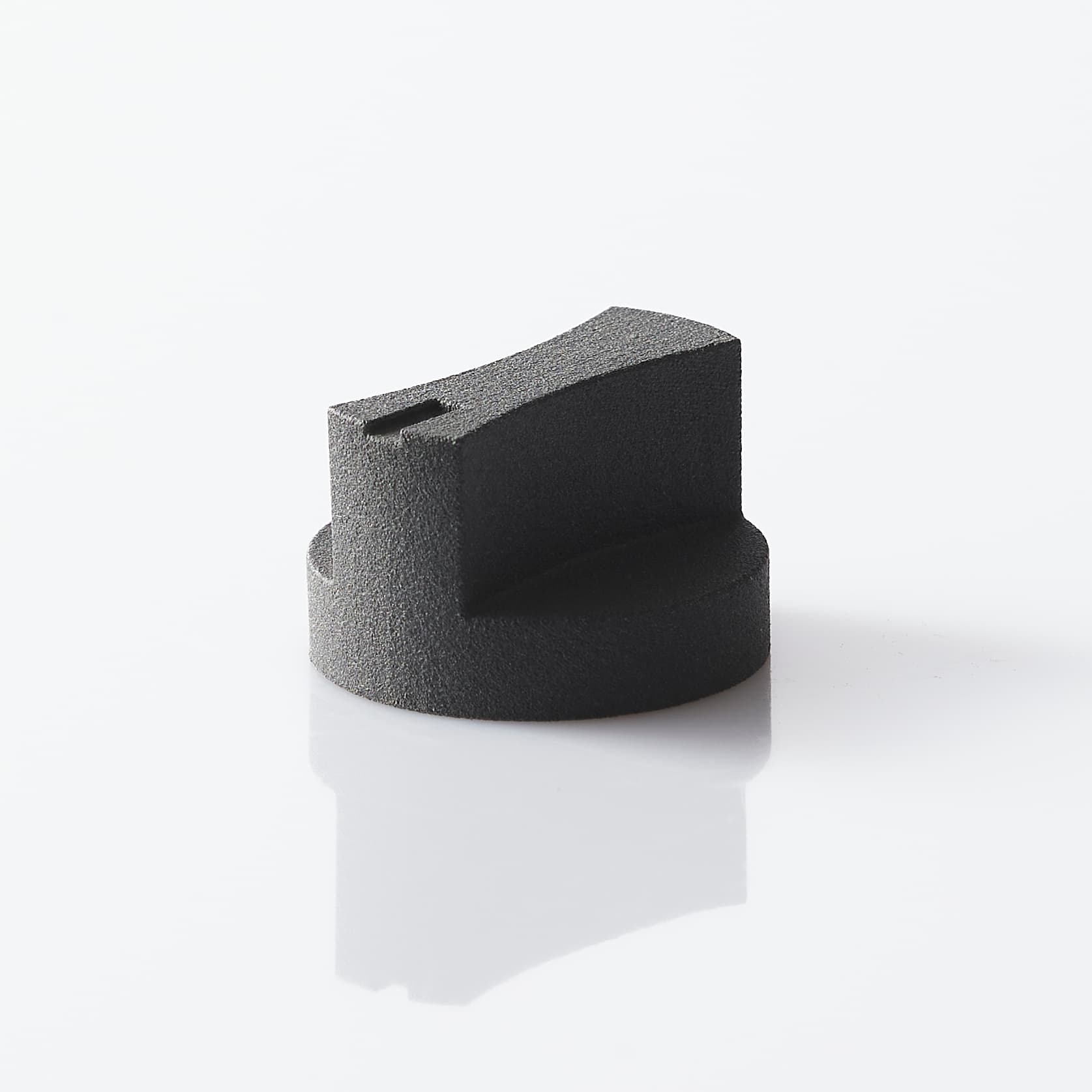
The operational advantage of SLS PA12 is the geometric freedom combined with properties suited to technical use. The standard surface remains slightly grainy compared with a resin-printed or machined part, but it can be treated by tumbling, dyeing or other finishes depending on the required function. Black dyeing, for example, improves aesthetic uniformity and visual legibility, without turning the part into an airtight component.
The limitation should be considered clearly. PA12 is not the automatic choice for high temperatures, specific chemical exposure or glossy aesthetic surfaces. In addition, critical dimensions must be managed with realistic additive tolerances and, when necessary, with subsequent machining. For a housing with bearings, threaded inserts or precision fits, it can be useful to provide machining allowance, finished seats or metal inserts.
When to choose PA12
PA12 is an effective choice when the part must be rigid but not brittle, lightweight, resistant to handling and repeatable in small runs. It is particularly suitable when geometric complexity would make traditional production costly or when the project has to evolve quickly through successive iterations.
For parts exposed outdoors or to industrial environments, finish, UV exposure and the fluids present must instead be assessed precisely. The datasheet figure is a starting point, not a complete validation of the application.
TPU: engineered flexibility, not generic softness
TPU is the material to consider when elasticity, shock absorption and controlled deformation are part of the function. Seals, cable grommets, guards, feet, anti-vibration elements, elastic covers and ergonomic components are typical applications.
The choice of TPU cannot be reduced to requesting a soft material. Hardness influences compression, elastic recovery, tear resistance and behaviour under load. An element that is too soft may collapse or lose stability; one that is too rigid may not absorb vibration or provide the intended travel. Geometry also profoundly changes the result: a thin wall, a lattice structure or a bellows changes the component's response more than the nominal hardness alone.
When designing a TPU part, it is useful to define how many times it will be compressed, stretched or bent. A prototype intended for a demonstration may need different performance from a component installed on equipment for thousands of cycles. Stress concentration points, sharp corners and section transitions must also be checked: these are areas that can reduce the part's service life.
TPU offers advantages that rigid materials cannot replicate, but it involves compromises in the accuracy of fits and in the handling of very thin walls. For this reason, checking the file before production is essential, especially for snap-fit seats, sealing lips and flexible geometries with tight tolerances.
Engineering MSLA resins: precision and targeted performance
Engineering resins printed with MSLA are appropriate when precision, detail and surface quality are priorities. They are used for dimensional prototypes, components with fine geometries, masks, master models and applications that require specific properties, such as greater stiffness, heat resistance or behaviour similar to certain engineering polymers.
MSLA technology selectively cures a liquid resin using UV light. The result can offer very well-defined surfaces and details that are difficult to achieve with extrusion processes. It is a valid choice for connectors, small containers, compact housings, micro-geometries and high-end presentation parts.
The main compromise concerns behaviour over time and under stress. Not all resins have the same toughness as PA12, and not all are suited to impact or continuous bending. Some formulations are excellent for precision and stiffness, but can be less tolerant of drops, stress concentrations and outdoor environments. Post-curing also affects the final properties: times, exposure and heat treatment must be controlled to obtain repeatable results.
When an industrial material needs to be simulated, the choice of resin must be checked against the priority requirement. A rigid resin is not necessarily equivalent to an ABS or polycarbonate component; a high-temperature resin does not automatically replace an injection-moulded engineering polymer. The comparison must be made on load, temperature, duration and actual mode of use.
Technology and material must work together
The same material gives a different result depending on the process. FDM is useful for rapid prototypes, tooling and components where time and cost must be kept down, accepting more visible layers and limits on overhangs. SLS is suited to PA12 and TPU parts with complex geometries, good repeatability and small-batch production. MSLA excels in detail definition and surface quality, especially with resins formulated for specific needs.
The choice should therefore not be made on technology in isolation. A component with thin walls, elastic clips and aesthetic surfaces may require a different solution from a structural bracket with internal channels. Similarly, a run of fifty pieces may make a different process more cost-effective than a single prototype, even with the same geometry.
Finishes, marking and requirements of use
The finished part does not always coincide with the part fresh off the printer. Support removal, depowdering, bead blasting, dyeing, sanding and dedicated treatments affect aesthetics, feel and functionality. If the component must be identified, tracked or customised, laser engraving and cutting can add codes, serial numbers, assembly references or technical markings.
The finish should be decided before printing, not after. A marking requires available area, sufficient contrast and consistent orientation. A mating surface may need to be protected from treatments that minimally change its dimension. A component exposed to the end user may instead require a higher aesthetic quality than that needed for an internal jig.
To reduce errors, the CAD file should arrive with the function of the part, the desired material if already defined, quantity, dimensional requirements and conditions of use. If this information is incomplete, a technical check can identify issues before production: insufficient walls, incompatible tolerances, threads to be rethought, fragile areas or finishes unsuited to the geometry.
Doppialinea works from file to finished part with complementary technologies and in-house process control. The value of technical consulting lies precisely in turning a generic requirement, such as "strong" or "flexible", into a verifiable production choice.
The choice of the best material becomes clear when the project is described for what it must do in the field. Bringing loads, environment, quantity and functional dimensions to the discussion means fewer attempts, earlier validation and parts that do not merely look right, but are designed to work.