A component that has to fit correctly into an assembly, carry repeated loads or work near heat sources is not chosen on appearance alone. Understanding how to choose PA12 nylon means starting from the real requirements of the part: function, geometry, operating environment, quantity and the level of finish required. PA12 is one of the most versatile materials in industrial 3D printing, but it is not automatically the right choice for every application.
In additive manufacturing, material, technology and post-processing work together. A good decision avoids needless iterations, reduces risk at the testing stage and takes you from the CAD file to a component ready for use with greater predictability.
Why PA12 nylon is a benchmark material for 3D printing
PA12 nylon, or polyamide 12, is used above all in SLS (Selective Laser Sintering) technology. In this process the laser sinters successive layers of polymer powder, making it possible to produce complex geometries without conventional print supports.
The result is a technical material with a good balance of mechanical strength, toughness, dimensional stability and low weight. Compared with many prototyping polymers, PA12 is suited not only to aesthetic mock-ups but also to functional prototypes, lightweight tooling, housings, brackets, clips, ducting, automation components and small runs.
Its low tendency to absorb moisture compared with other polyamides helps keep performance more stable in variable environments. This does not mean the material is insensitive to conditions of use: it means it offers a generally more manageable behaviour when the part is exposed to humidity, frequent handling or climate variations.
How to choose PA12 nylon according to the function of the part
The first question is not "how strong is PA12?", but "what stress will the component have to carry?". A part subject to impact, bending and repeated assembly requires a different assessment from a rigid support or a purely protective housing.
For elements such as clips, elastic tabs and snap-fit systems, PA12 is often a valid solution thanks to its toughness. The geometry remains decisive, however: thicknesses that are too thin, sharp internal corners or stress concentrations can cause failure even with a suitable material. In these cases, fillet radii, ribs and the orientation of the elastic feature must be checked already in the CAD.
For brackets and supports under load, intensity, direction and duration of the stress must be assessed. PA12 can work well under moderate, distributed loads, but it must not be treated as an automatic replacement for aluminium, steel or reinforced engineering polymers. If the component is safety-critical, works under continuous load or has specific regulatory requirements, design verification and testing on the real part are needed.
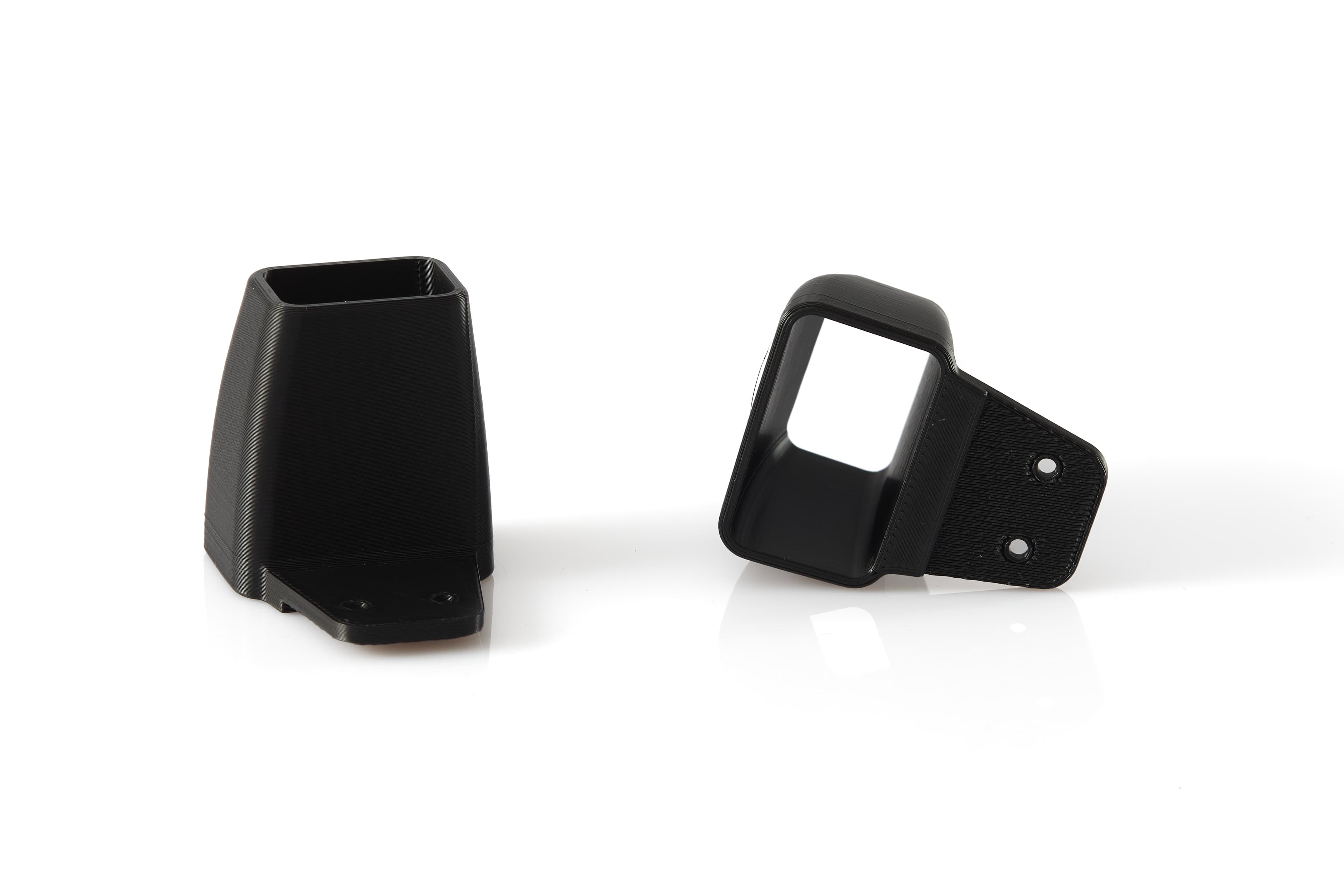
For housings, covers and functional enclosures, PA12 offers a good compromise between robustness, lightness and geometric freedom. It is particularly suitable when interlocks, internal passages, insert seats, grilles or organic shapes are needed that are difficult to make quickly with traditional machining.
Geometry, thicknesses and tolerances: the material does not correct the design
SLS printing with PA12 allows considerable freedom of shape, but does not remove manufacturability constraints. Very thin walls can deform or be fragile; very compact masses can retain heat during the process; closed cavities with no evacuation holes prevent the removal of unsintered powder.
As a design rule, it is useful to avoid abrupt changes of section and prefer gradual transitions. Ribs increase stiffness without making the component excessively heavy. Fillets reduce stress concentrations, especially near holes, connections and the bases of cantilevered elements.
Tolerances should also be defined according to the interface. A free fit, a guided slide and a press fit require different clearances. There is no universal value: part size, orientation, geometry, planned finish and the behaviour of the assembly all play a part. When the part has to work with metal elements, bearings, screws or other standard components, it is advisable to indicate the functional dimensions and critical surfaces from the outset.
CAD files and functional dimensions
A well-generated STL file can be enough for many jobs, but a STEP file simplifies the technical check when important dimensions, complex mating features or optimisation requests are present. The difference is concrete: a solid model allows walls, radii, holes, intersections and details that must be preserved to be checked more precisely.
The dimensions that determine how the assembly works should be clearly identified. This allows technical attention to be concentrated on the points that really matter, instead of applying tight and costly tolerances to the whole component.
Operating environment: heat, chemical agents and outdoor use
PA12 should not be chosen on the basis of strength at room temperature alone. A component installed near motors, power electronics, industrial fluids or heat sources must be assessed in its complete context.
The material offers good chemical resistance to several agents, but compatibility depends on the substance, concentration, contact time and temperature. Oils, solvents, detergents and fuels do not necessarily produce the same effect. For an application with continuous exposure, a functional sample and a targeted test are more reliable than a choice based on the datasheet alone.
Exposure to UV rays also deserves attention. For outdoor components, colouring and surface treatment can contribute to aesthetic protection, but do not replace an assessment of the expected life. If the part has to maintain critical characteristics for years outdoors, it is right to define a validation plan.
PA12 finish: appearance, cleanliness and function
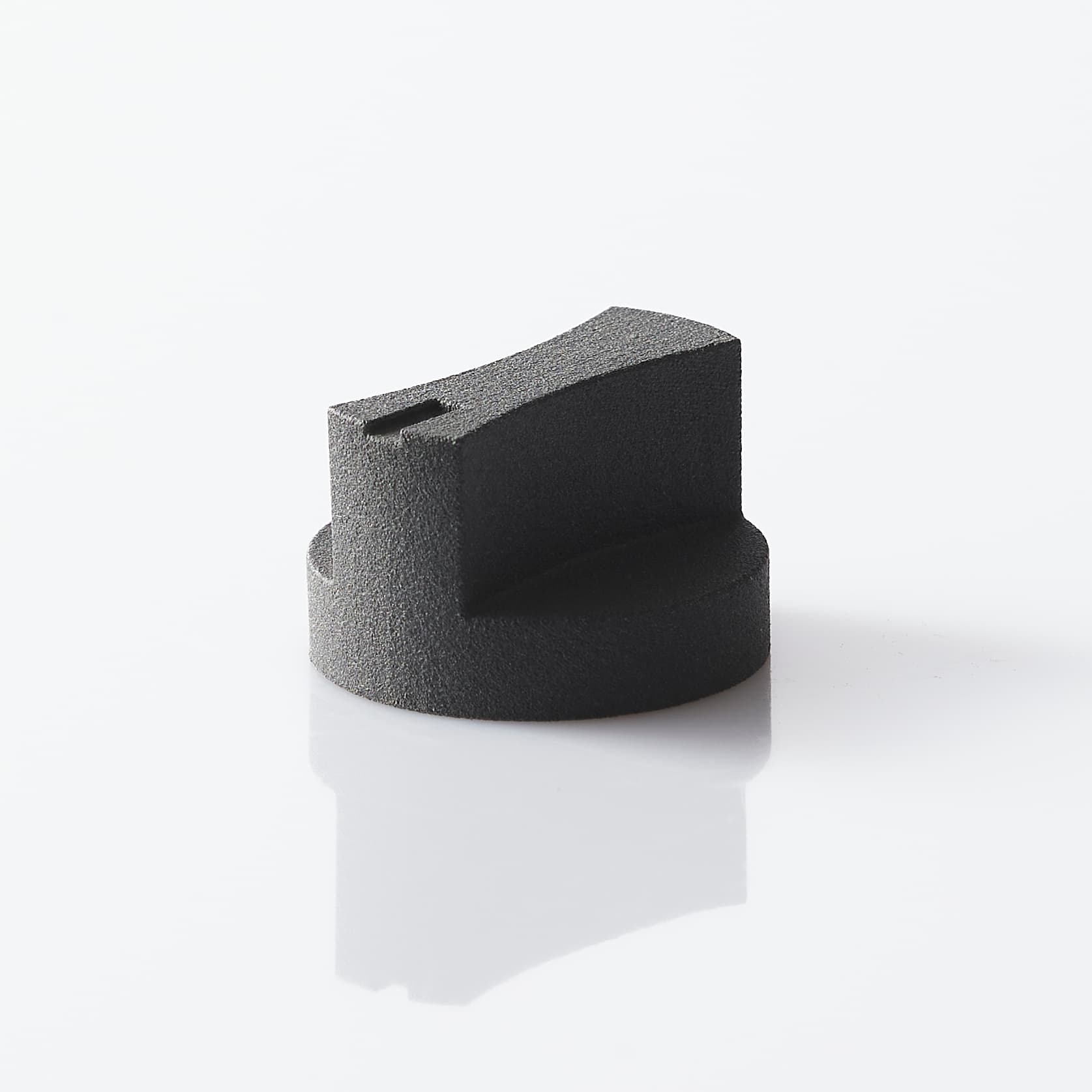
An SLS component in PA12 leaves the process with a slightly grainy, matt surface. This natural finish is often suitable for technical parts, tooling and functional prototypes. When the part is visible, has to be handled often or requires clear identification, post-processing becomes part of the material choice.
Bead blasting evens out the appearance and removes powder residue. Dyeing gives more consistent colours and can improve the perceived quality of the component, without turning it into an injection-moulded part. For products intended for demos, pre-series or professional use, this difference is relevant.
Markings, identification codes, revision numbers and logos can be integrated through laser engraving. It is a useful solution for traceability, variant management and industrial personalisation. If the marking is functional, it must be provided for in the geometry with a sufficiently accessible and legible area.
When PA12 is not the best choice
The right choice also depends on the limits of the material. If the part must be very flexible and recover from large deformations, a TPU may be more suitable. If extremely fine details, very smooth surfaces or micro-geometries are needed, a specialist MSLA resin can offer superior definition, though brittleness and long-term behaviour must be assessed carefully.
If the main requirement is maximum structural stiffness, resistance to high temperatures or very specific performance in a severe environment, it may be necessary to consider reinforced materials, high-performance polymers or different production processes. PA12 is a balanced choice, not a universal answer.
Another case to assess is high-volume production. 3D printing is effective for prototypes, pre-series, spare parts and limited batches, especially when variants are numerous or the geometry is complex. As quantities grow, it is useful to compare costs, lead times and dimensional requirements with technologies such as injection moulding or CNC machining.
A practical method for deciding
Before requesting a quote, gathering some information reduces time and ambiguity: function of the part, expected loads, environment of use, quantity, desired finish, colour, critical dimensions and delivery date. You do not need to arrive with a perfect specification, but these data make the technical check far more useful.
As a first choice, PA12 is a solid candidate when light, strong parts with complex geometries and repeatable quality in small batches are needed. It is particularly suitable when the component must be more than a simple visual representation and has to face assembly, testing or operational use.
The final decision should come from comparing file, function and real conditions. Doppialinea works precisely on this step: from manufacturability checking to printing, from finishing to delivery of the component ready for testing or use. A requirement well described at the start almost always leads to a more reliable part in the first production cycle.